Report on Initial Lifecycle Sustainability Assessment- Framework and comprehensive list of Sustainability Indicators
 | Corinna BaumgartnerLecturer & Researcher Technology Assessment & Circular Economy |
Abstract
In Switzerland, buildings are one of the major sources of CO2 emissions accounting for ~24% of the total. Therefore, to achieve the requests posed by the Paris agreement, these emissions need to be reduced. In this context, this can be achieved either by efficient envelopes (reduction of energy demand) and/or by switching from fossil fuels to renewable energies. While such measures are straightforward in the case of new buildings, retrofit of the existing building stock is more complex.
The RENOWAVE project aims at boosting the retrofit of the Swiss building stock, both in terms of quantity (renovation rate) and quality (performance), as to help achieve the objectives formulated for the building sector in the Swiss long-term climate strategy. To accomplish this goal a holistic, value-chain oriented approach is adopted in RENOWAVE to contribute achieving several SDGs including socio-economic as well as environmental ones (7,8,12,13). The holistic approach aims at solving several multifaceted, interrelated, and transdisciplinary challenges that rise from the massive and efficient retrofit of the existing Swiss building stock. These challenges have been allocated to several individual sub-projects (SPs) clustered in different thematic pillars in RENOWAVE.
In SP1.4 a comprehensive sustainability framework specifically tailored to the sustainability, resilience and decarbonization targets and policies of the Swiss government and consider the needs and perspectives of the diverse stakeholders in the building sector is derived. The final aim of SP1.4 is to realize a tool that allows stakeholders to compare different potential renovation measures with respect to the current state of the building under interest by means of providing ranking and scores of each alternative.
This report presents the initial development of such a tool, called Life-Cycle Sustainability Assessment-Framework (LCSA-F), for multifamily houses renovation measures. The LCSA-F combined the Environmental Life Cycle Assessment (eLCA), Life Cycle Cost (LCC), Social Life Cycle Assessment (sLCA) and Resilience Assessment (RA) domains within the overarching Multi-Criteria Decision Analysis (MCDA) method. Therefore, the tool makes use of one of the main family of MCDA methods, which is represented by composite indicators (CIs), or indices, since it leads to a score of the alternatives that can then be easily ranked.
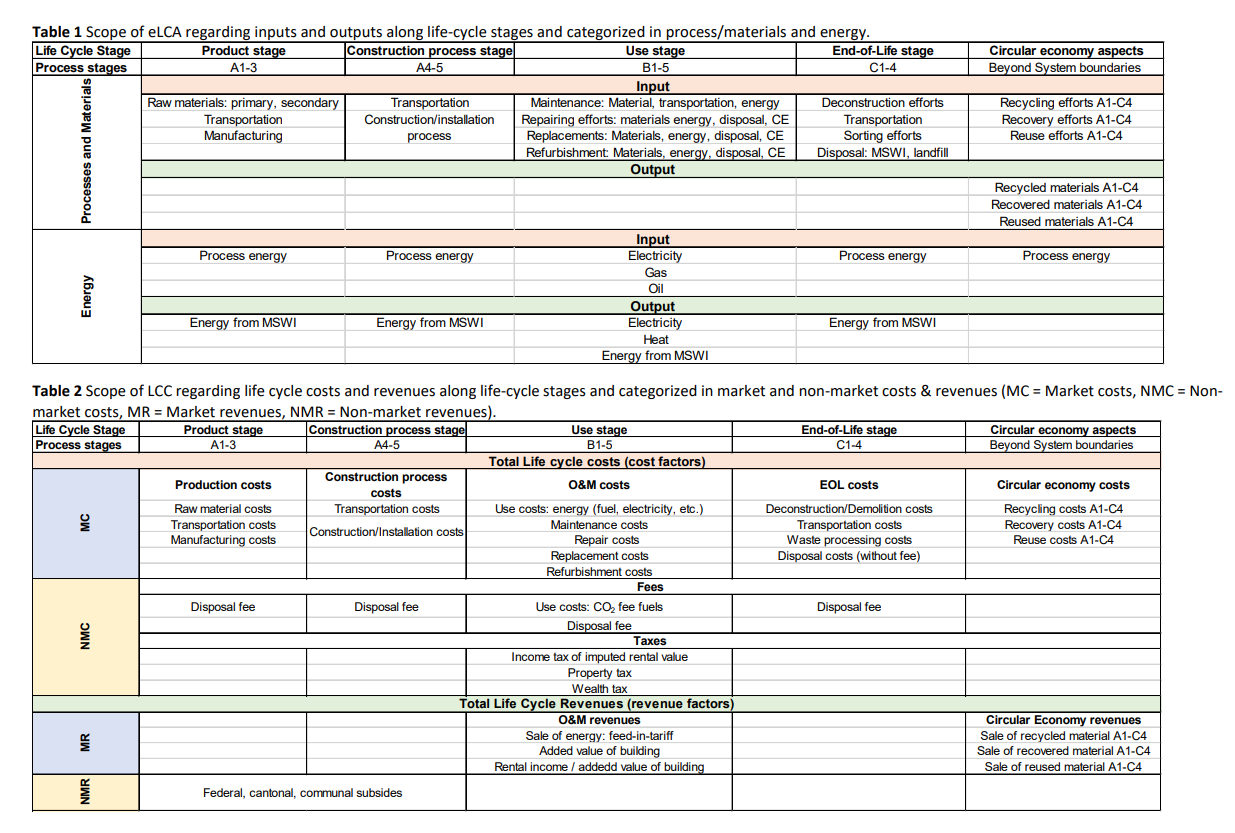
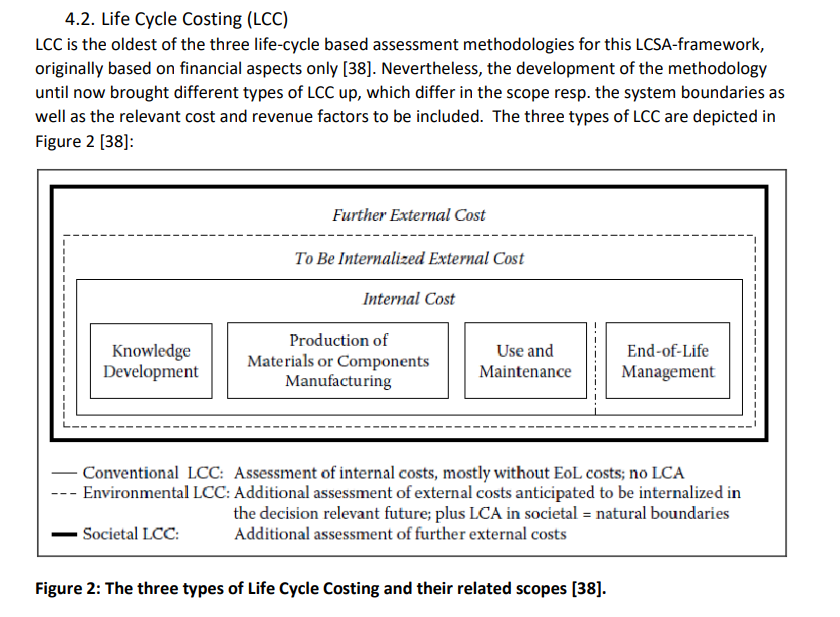
The initial development of the proposed framework was achieved in close collaboration with a group of 8 experts from academia, construction enterprises, consulting, etc., to grasp the heterogeneous knowledges and interests from these different domains. Particularly, the experts participated to 2 workshops to help defining the proposed framework. In the 1st workshop the experts were asked to define the system boundaries of the framework and their level of details. In this context, the group uniformly voted for covering the whole life cycle including the product stage, the construction process stage, the use stage, and the end-of-life stage as well as presenting all results at the process stage level. Furthermore, the experts voted the functional unit (FU) for the LCSA-F, which results to be “heated area per year of building lifetime” due to its wide application in the Swiss building context expressing the building’s energy demand. Moreover, during the 1st Workshop, the group of experts selected the criteria to be included in the framework, since CIs are based on an aggregation of criteria that measure different domains. In this context, the framework presented here is based on a hierarchical structure of the criteria, which is composed by 3 layers. In the first layer the four abovementioned domains, i.e., eLCA, LCC, sLCA, RA, are present. The second layer is composed by a set of 16 criteria, subdivided into 5 for eLCA and sLCA, 4 for RA and 2 for LCC, which were defined based on a comprehensive literature review and the expert selection during the 1st Workshop. The 3rd layer of the hierarchical structure of the framework contains a set of 56 subcriteria, subdivided into 10 for eLCA and sLCA, 9 for LCC and 27 for RA, which were selected based on a comprehensive literature review and in accordance with the group of experts. Once the criteria hierarchical structure of the LCSA-F was defined, during the 2nd Workshop, the experts were asked to weight the 2nd and 3rd level of the hierarchy to build a default preference profile, different to the equal weight one, to be included in the tool under development. Finally, based on the problem type, the criteria and sub-criteria nature, the preference elicitation, and the features of aggregation under interest, the most reasonable MCDA method for the tool under development was selected. In this context, the MultiAttribute Value Theory (MAVT) was found to be the best methodological solution based on the MCDA-MSS tool.
Authors: Baumgartner, Corinna; Lobsiger-Kägi, Evelyn; Spada, Matteo.