Energy building analysis considering different ownership types
 | Matthias HaaseProfessor |
Abstract
In Switzerland, the building sector accounts for around 40% of the country’s final energy consumption and contributes roughly one-third of CO₂ emissions, mainly from the use of fossil fuels for heating.(BFE, 2023). National strategies such as Energy Strategy 2050 and recent climate legislation set ambitious goals to reach net-zero CO₂ emissions in the building stock by 2050(SFOE, 2024). To this end, deep renovations, the deployment of heat pumps, and the integration of renewable energy are promoted through financial incentives, such as subsidies and tax deductions (Beringhs et al., 2025). Nevertheless, the number of buildings undergoing energetic renovation has been very low in recent years. This indicates that current policy initiatives are insufficient to encourage large-scale energy renovation.
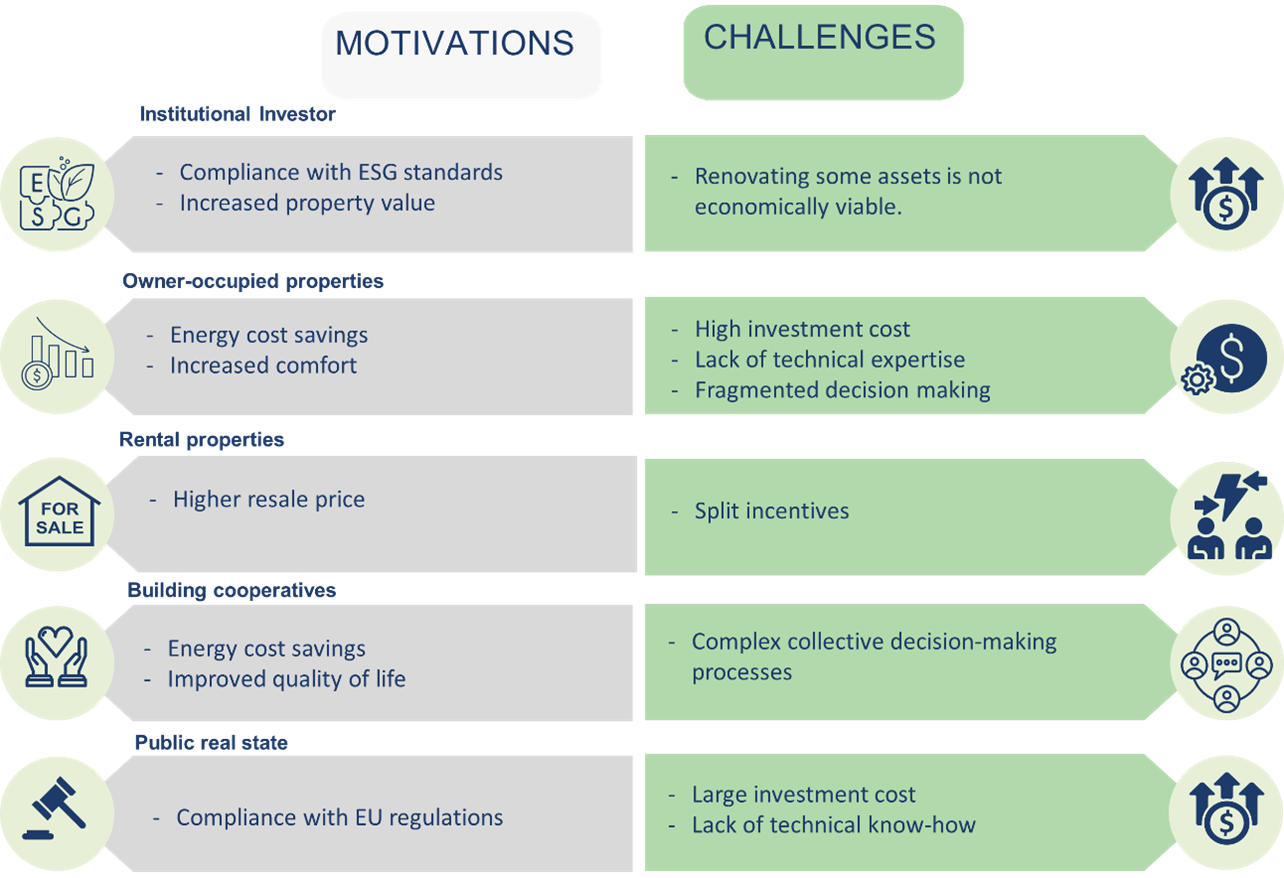
The aim of this report is to explore the opportunities that arise from differentiating ownership types in the planning of a Swiss municipality. In the following section, we describe the challenges and motivations for energy renovation faced by different types of owners, based on the literature. The report then outlines the process for obtaining ownership data in Switzerland, followed by an example application of ownership classifications for building benchmarking. Finally, it concludes with a discussion of how ownership data can be leveraged in future projects to inform and improve policy design and business model development.
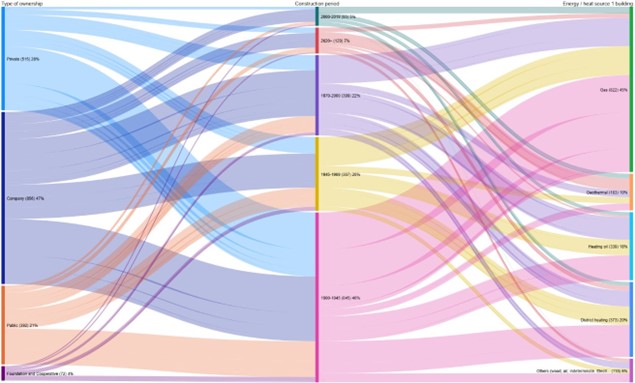
This report investigates the influence of ownership structures on building energy efficiency. Following a review of the relevant literature, an empirical analysis was conducted to assess the situation in the municipality of St. Gallen, Switzerland.
The analysis shows that non-residential buildings are predominantly owned by companies, often representing institutional investors. This ownership category exhibits the highest energy performance, characterized by lower specific energy demand and, by a substantial margin, the largest installed photovoltaic (PV) capacity. These findings are consistent with results reported in the literature, notably those indicating that buildings owned by institutional investors display the lowest CO₂ emissions within the Swiss building stock (Spuler et al., 2020).
Overall, the results highlight the necessity for policy instruments and support mechanisms tailored to the specific needs and constraints of different ownership types (Azizi et al., 2019; Mangold et al., 2018; März, 2018a; Petkov et al., 2021). While corporate-owned buildings are clearly leading the decarbonization process, private owners, foundations, and smaller corporations require targeted support. Measures such as one-stop-shop solutions that simplify planning, financing, and implementation of renovation projects could significantly lower existing barriers.
Future research should focus on the development of innovative business models that address the heterogeneous needs of different ownership types. This includes designing decision-support tools adapted to owner-specific incentives and constraints, as well as exploring strategic policy frameworks capable of accelerating deep renovation and decarbonization across the entire building stock.
Referenzes
Azizi, S., Nair, G., & Olofsson, T. (2019). Analysing the house-owners’ perceptions on benefits and barriers of energy renovation in Swedish single-family houses. Energy and Buildings, 198, 187–196. https://doi.org/10.1016/j.enbuild.2019.05.034
Beringhs, A., Wagner, J., & Wanzenried, G. (2025). Exploring Swiss homeowners’ renovation decisions: A latent class analysis approach to inform policy. Energy and Buildings, 349, 116494. https://doi.org/10.1016/j.enbuild.2025.116494
BFE. (2023). Gebäudepark 2050 – Vision des BFE. https://www.bfe.admin.ch/bfe/en/home/effizienz/gebaeude.exturl.html/
Petkov, I., Knoeri, C., & Hoffmann, V. H. (2021). The interplay of policy and energy retrofit decision-making for real estate decarbonization. Environmental Research: Infrastructure and Sustainability, 1(3), 035006. https://doi.org/10.1088/2634-4505/ac3321
SFOE, S. F. O. of E. (2024). Buildings. https://www.bfe.admin.ch/bfe/en/home/effizienz/gebaeude.html
Spuler, Thomä, & Frey. (2020). Bridging the Gap. https://www.bafu.admin.ch/dam/it/sd-web/vwK-y01mZ4NE/def-bridging-th
| Attached files | |
| Abstract |  |
| RENOWAVE24 OWNERSHIP STRUCTURE report_final | |